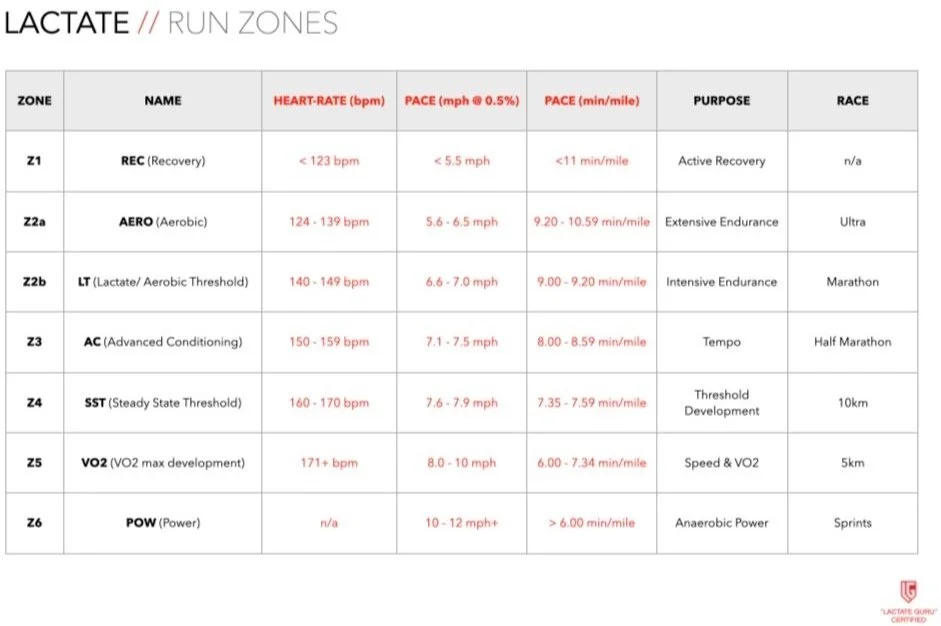
Your lactate threshold heart rate is the number on your monitor when the lactate in your blood starts to climb away from its baseline. Every endurance athlete has one and many have never had it measured. They go by a formula or a guess, and most athletes train above their easy ceiling without knowing it. That is why easy days stop being easy. If you are heading into a winter base block, this is the number to get right FIRST.
WHAT IS LACTATE AND WHY DOES IT HAVE A THRESHOLD?
Lactate is constantly produced by the body. At rest and in light exercise the amount is small enough that your body uses it as fuel or buffers it. As intensity increases, production increases and reaches levels that reflect a loss of aerobic efficiency. That point is your “threshold”.
Heart rate is how you carry that information out onto the road. It tells you how stressful a workout is and it guides you to the intensity. Fat burning requires a low-stress environment, so on your easy days you want that heart rate low. Your threshold heart rate puts a number from your own blood on the dial.
ARE THERE TWO LACTATE THRESHOLDS?
Yes. So when you see “lactate threshold heart rate” written down, the first question is which one. We look for 2 specific markers from the lactate test :
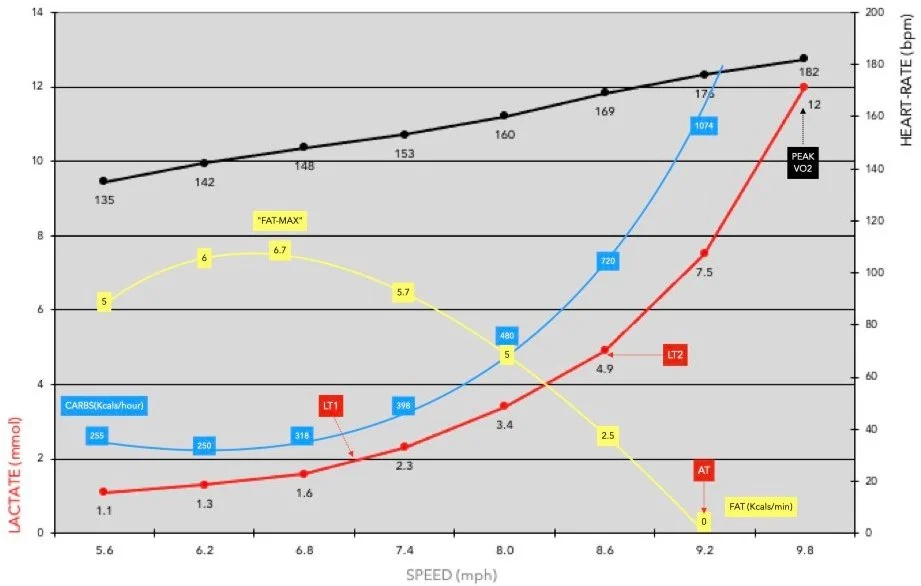
- Aerobic threshold (AeT, or LT1) : the first shift away from a baseline of lactate production. It is a “moderate” effort for most athletes, usually around 2 mmol, though it can vary from 1.5-2.5 mmol depending on the type of athlete. This is the ceiling on genuinely easy work and the top of your Zone 2.
- Steady state threshold (SST, or LT2) : the last intensity where lactate stays the same as time goes on, hence “steady state”. For many athletes it is around 3.5-4.5 mmol though that can vary widely. There is often a spike in lactate soon after it, which helps me spot it. This is the number that sets realistic race pace.
Each one comes with a heart rate attached. They are different zones on your monitor, so mixing them up puts a session in the wrong place. LT1 matters most for long events (think IRONMAN, marathon, ultra) and for building your Zone 2. LT2 is where your threshold work lives.
HOW DO I FIND MY LACTATE THRESHOLD HEART RATE?
There are a few ways and they are not equal. Here they are in the order I trust them.
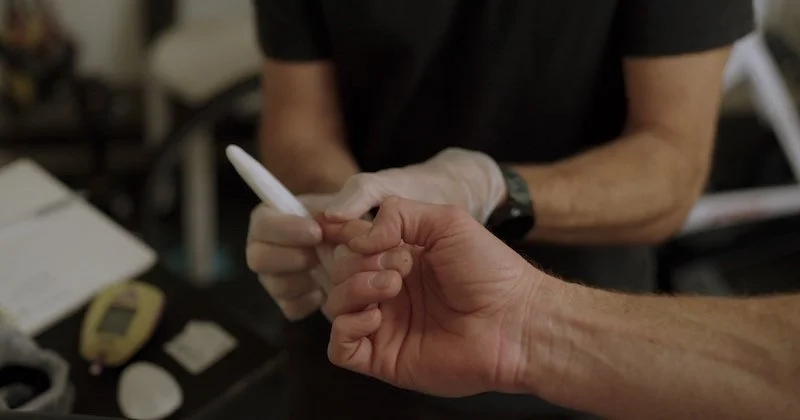
1. Lactate test // The #1 gold standard, used by the best of the best. You test in your own sport (a treadmill for runners, your own bike on an ergometer for cyclists) and work through 4-8 stages of gradually increasing effort. At the easier stages each one lasts 4 minutes, which gives your lactate and heart rate time to settle. After each stage a small blood sample is taken from a fingertip or earlobe with a fresh single-use needle and you keep moving. The whole test takes 30-40 minutes. Plot the lactate against heart rate, power or pace and both thresholds show up with a heart rate beside each. I explain why the test works in What is lactate threshold testing?
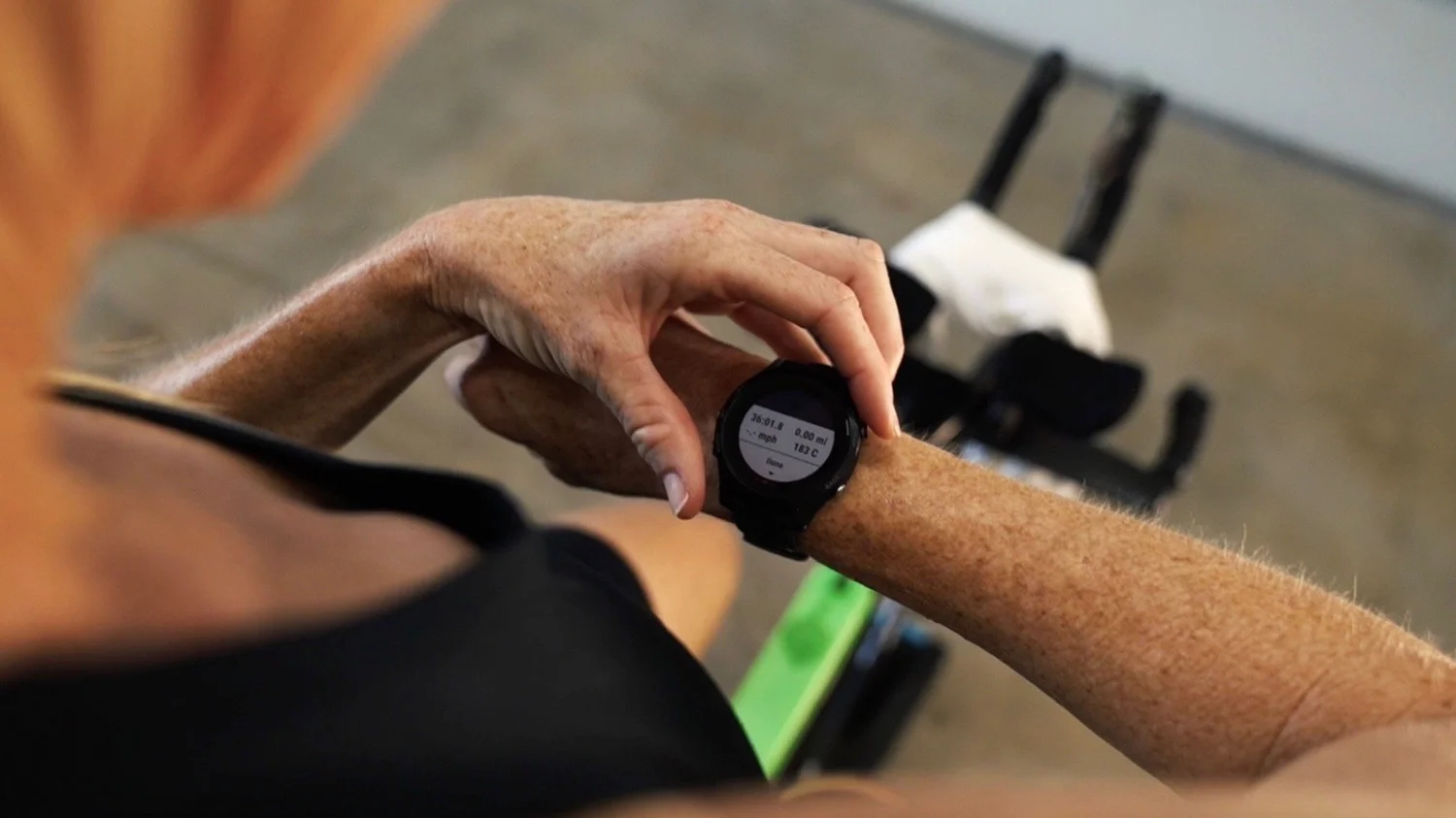
2. Field test // A hard, steady 40-minute effort, with the lap button pressed at the start and the end. I use 40 minutes because the standard 20-minute FTP (functional threshold power) or FTHR (functional threshold heart rate) test often gives results that are too flattering and too high. I’ve had hundreds of people tell me their LT2 is at, say, 250 watts or 160 bpm after a 20-minute FTP or FTHR test, only to find out once they visit the lab that it was as much as 50 watts or 10 bpm too high when we had accurate metabolic data from lactate. A 20-minute test is a good “performance” test, but not a good one for setting zones or thresholds. I give my athletes field tests every 4-8 weeks to check progress. I always use the set and controlled environment of the sports laboratory to measure metabolic changes and separate field tests to measure the ability to “perform”.
3. A formula // Taking 220 minus your age and multiplying it by 80-85% for LT2, or the old 180 minus your age for LT1, is a “guess-timate”, and often a massively inaccurate one. Take me for example. At 55 years old, in theory my max heart rate is 165 bpm, 85% of that is 140 bpm for LT2, and 180 minus 55 is 125 bpm for LT1. Well, I can hit 184 bpm at the end of a 5km run test (19 bpm higher than predicted!), my lab-measured LT2 is 164 bpm (99% of my predicted “max heart rate”) and my Zone 2 is 131-152 bpm, which is up to 27 bpm above the predictions!! Using ANY formula would have me hugely under-training, and this is common with many athletes who use formulas to gauge LT1 or LT2.
The talk test falls over too. Many newbies can talk easily with lactate at 3-4 mmol, whereas an IRONMAN triathlete can be working hard at 1.9 mmol and find talking hard work. A VO2 test is a useful second step for fat and carb use, best done AFTER a lactate test.
WHAT IS A GOOD LACTATE THRESHOLD HEART RATE?
People want a number to compare with their training buddies and I understand why. There is no “good” one. Your threshold heart rate belongs to YOU, and if you copy your buddy’s number or a formula’s you are training to someone else’s engine.
What shows you are improving is the power or pace beside the heart rate. Over time, with the right aerobic training, lactate at a given workload goes down. That is a metabolic gain. You get less lactate at the same power or pace, or the same lactate at a higher power or pace. In heart-rate terms you will see a lower heart rate at the same power or pace, or more power or pace for the same heart rate.
WHY DOES MY HEART RATE CHANGE FROM DAY TO DAY?
Your threshold is measured on one day in one set of conditions, then you carry it out into a world where conditions keep changing. These all move the heart rate you see for the same effort :
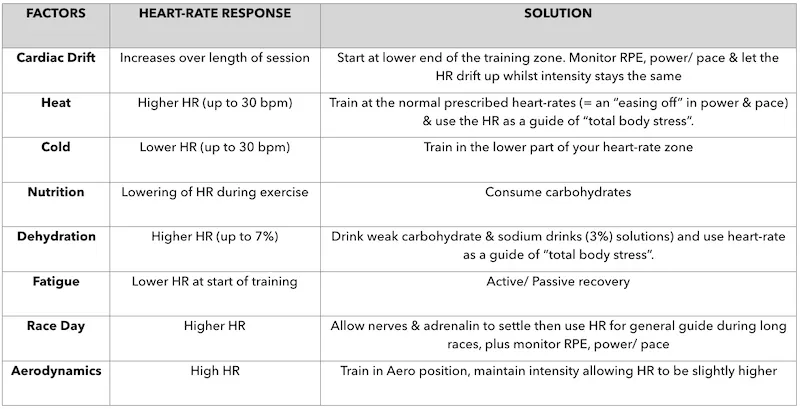
- Heat : 10-30 bpm higher with no change in power or pace
- Cardiac drift : up to 20 bpm higher late in a long, moderate session, from a rise in core temperature
- Dehydration : heart rate up 2-7% (that’s up to 160 bpm from 150)
- Cold : can stay lower than you expect, even though you are working harder
- Fatigue : a heart rate that won’t rise like it normally does
In the heat, train at your normal prescribed heart-rate zones, which means easing off in power or pace. In the cold, train in the lower part of the zone. I go through each of these in The do’s and don’ts of heart-rate training.
This is also why I test in a repeatable environment, so one test can be compared with the next.
HOW OFTEN SHOULD I RETEST?
Every 9-12 weeks. That is long enough for a training block to produce real change and short enough that your zones do not drift out of date while you are still training to them. Training with old data can be as bad as training with no data !! So be prepared to commit to regular assessments and watch your fitness grow year upon year.
Once you have your two numbers, use them. Long, easy base work stays below LT1. Threshold sets sit at LT2, for example 10 x (5 minutes at threshold off 1 minute of easy recovery), which I cover in The need for speed. Do the easy work properly first, because peak speed only comes after a solid aerobic base!
If you would rather have your own two numbers than a guess, a lactate threshold test at my lab gives you both, with the heart-rate zones built from them, read back to you in person. Call (858) 361-4733 to book.