Running
- Basic$350Lactate
- Pro$575LactateVO2 max
- Ultimate$675LactateVO2 maxRMR
The most precise picture of how your body clears lactate — and the intensity you can actually hold.
Race performance & training zones. Lactate testing is the better choice if you are training for a race — it is how you find the intensities you can actually hold, rather than a heart-rate zone guessed from your age.
A blood lactate test is the gold standard for setting up accurate, personal heart-rate and pace training zones, especially for competitive athletes. During a sub-maximal exercise test, blood lactate samples are taken along with heart-rate, power or pace, and hydration data while you exercise at gradually increasing intensities. This data is analysed and delivered as an easy-to-use, practical prescription. The zones are based on heart rate, power and pace to suit your unique fitness and wellbeing goals.
Every test is run and read by Gareth Thomas, the Lactate Guru —Coach to world & national champions · 30+ years. You do not get emailed a PDF and left to interpret it.
Lactate is constantly produced by the body. At its simplest, energy in the form of ATP is essential for muscle contraction and can be produced via aerobic or anaerobic pathways. At rest and in light aerobic exercise, the level of lactate produced is small enough that it is used as fuel, or buffered. As intensity increases, lactate production increases and reaches levels that are reflective of a loss of aerobic efficiency.
In general, low levels of lactate are the sign of an efficient aerobic, fat-burning system. High lactate levels at easy workloads are a sign of an underdeveloped aerobic system. High lactate levels at maximal workloads are a sign of a well-developed anaerobic system. For each athlete and sport there is an optimal balance of aerobic and anaerobic qualities. Testing unveils that balance.
Over time, with correct aerobic training, lactate levels at a given workload will decrease — showing an improvement in aerobic conditioning. That is a metabolic gain: less lactate at the same power or pace, or the same lactate at a higher power or pace. Guessing from how a session felt cannot tell you which one you got.
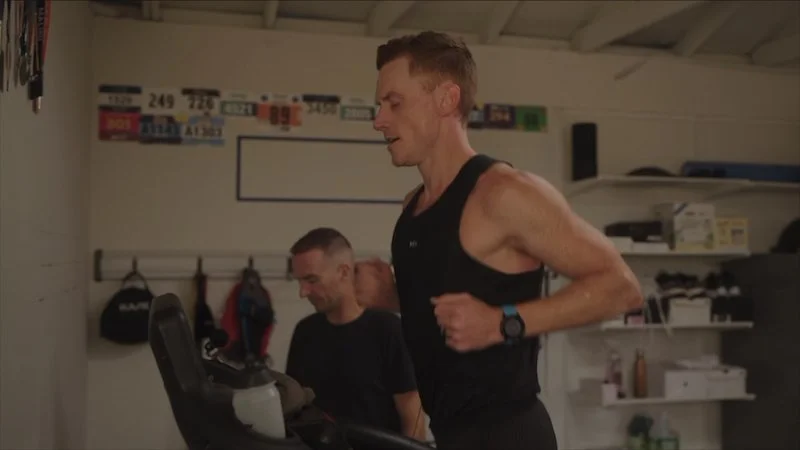
One of the main advantages of lactate testing is that it is robust: more stable, and less open to big swings in levels from day to day. That is why it is the number-one test of choice here, and why it is used to set your optimal training zones — heart-rate, plus power or pace if you have access to measuring those too. Tests are available for cycling, running, swimming and rowing. You test in your own discipline — a bicycle ergometer on your own bike for cyclists, a treadmill for runners, and for triathletes both of those and sometimes a pool-based swimming test. The data is only useful if it comes from the movement you actually train.
Step one in the process is usually the lactate test. You test in your own discipline — a bicycle ergometer on your own bike for cyclists, a treadmill for runners, and for triathletes both of those and sometimes a pool-based swimming test.
A test session takes 30–40 minutes of actual testing, progressing through 4–8 stages. Allow around an hour in total. Retest every 9–12 weeks — long enough for a training block to produce real physiological change, short enough that your zones do not drift out of date.
You test in your own discipline — treadmill for runners, ergometer for cyclists, pool for swimmers. The data is only useful if it comes from the movement you actually train.
The session steps up through 4–8 stages of increasing intensity. Each stage is held long enough for your body to settle at that effort before anything is recorded.
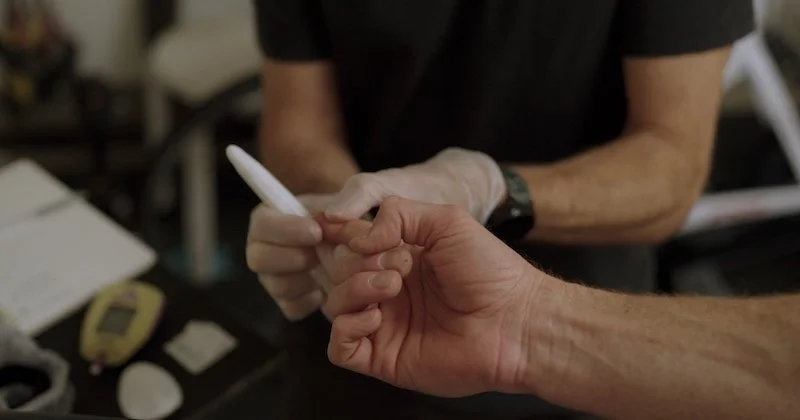
A small blood sample is taken at the end of each stage with a fresh single-use needle. It takes seconds and you keep moving between stages.
You do not get emailed a PDF and left to interpret it. Every test is read back to you in person, in plain language, with what to change on Monday morning.
The session steps up through 4 to 8 stages of gradually increasing intensity, depending on your current fitness level. Each stage is held long enough for your body to settle at that effort before anything is recorded. After each stage a small blood sample is taken from a fingertip or earlobe with a fresh single-use needle. It takes a few seconds. Most people describe it as a brief pinprick. You keep moving between stages.
The whole test lasts usually in the 30–40 minute range. Allow around an hour in total, which includes the setup and the consultation where Gareth reads your results back to you in person, in plain language, with what to change on Monday morning.
A heart-rate zone calculated from your age is a guess about a stranger. These two marks are measured from your own blood, on the equipment you actually train on. They are where your training zones actually begin and end.
The aerobic threshold — AeT, or lactate threshold 1 (LT1) — is the first shift away from a baseline of lactate production. It is a moderate effort for most athletes, usually somewhere between 1.5 and 2.2 mmol of lactate. Knowing this is very helpful for long-distance performance — think Ironman, marathon, ultra — and for the development of Zone 2. Often a high percentage of fat is being used for energy here, and this can often correlate to Fat-Max. On a typical curve the top of Zone 2 sits at 2 mmol. Those millimole figures describe a staged response. They are not your personal numbers.
Steady-state threshold — SST, or lactate threshold 2 (LT2), also called maximum lactate steady state (MLSS) or onset of blood lactate (OBLA) — has many names that try to lead to the same place. This is the last intensity where lactate concentrations will stay the same as time progresses, hence “steady-state”. For many athletes it is around 3.5 to 4.5 mmol of lactate, though that can vary widely. Often there is a spike in lactate production soon after this intensity, which helps identify it. This is the number that sets realistic race pace. On a typical curve Zone 4 is the narrow band just below and just above 4 mmol.
The ceiling on genuinely easy work. Most athletes train above this without knowing it, which is why easy days stop being easy.
The hardest intensity you can hold at a stable lactate. This is the number that sets realistic race pace.
Delivered as heart-rate and pace or power ranges you can load straight into your watch or head unit.
You leave with your personal heart-rate training zones, your aerobic and steady-state thresholds, your Fat-Max intensity, custom workouts built from your own numbers, and a fuelling and hydration plan. Every test is explained in person rather than emailed over as a report.
The zones are delivered as heart-rate and pace or power ranges you can load straight into a watch or head unit. One of the main things people come to the lab to find is their Zone 2. We do find this, and it is vital for the full development — and the health — of the aerobic system. We also find the thresholds and the balance of the aerobic and anaerobic systems, then tune those systems through accurate heart-rate zone training.
We try to test in a repeatable environment so we can compare tests done throughout the season and against previous years. Each athlete should retest every 9 to 12 weeks to monitor progress.
Running, cycling and triathlon packages that include a blood lactate test. Most people want more than one number — these bundle the tests that actually go together, at less than booking them separately.
Every price includes the consultation and a full explanation of your results. Call (858) 361-4733 if you are not sure which package to book.
Still not sure? Call (858) 361-4733. There's no sales pitch — if a test isn't worth it for you, he'll say so.
A blood lactate test measures how your body produces and clears lactate as intensity rises, which gives you your aerobic and threshold training zones. A VO2 max test measures the maximum amount of oxygen your body can use during intense exercise, which gives you your aerobic ceiling and your Fat-Max fuelling intensity. Lactate testing is the better choice if you are training for a race; VO2 max is the better choice if you want a single objective marker of cardiovascular fitness.
A test session takes 30 to 40 minutes of actual testing, progressing through 4 to 8 stages. Allow around an hour in total, which includes the setup and the consultation where Gareth reads your results back to you.
It is a small sample taken from a fingertip or earlobe with a fresh single-use needle after each stage, and it takes a few seconds. Most people describe it as a brief pinprick. You stay on the treadmill or bike throughout.
No. Roughly half the people tested at the lab are not racing anything. RMR and VO2 max testing are used just as often for body composition, longevity and general health as they are for performance, and the protocol is scaled to whatever you can currently do.
Every 9 to 12 weeks. That is long enough for a training block to produce real physiological change and short enough that your zones do not drift out of date while you are still training to them.
You leave with your personal heart-rate training zones, your aerobic and steady-state thresholds, your Fat-Max intensity, custom workouts built from your own numbers, and a fuelling and hydration plan. Every test is explained in person rather than emailed over as a report.
A blood lactate test is $350, a VO2 max test is $275, and an RMR test is $175. A combined VO2 max and RMR test in one visit is $450. Every price includes the consultation and a full explanation of your results.
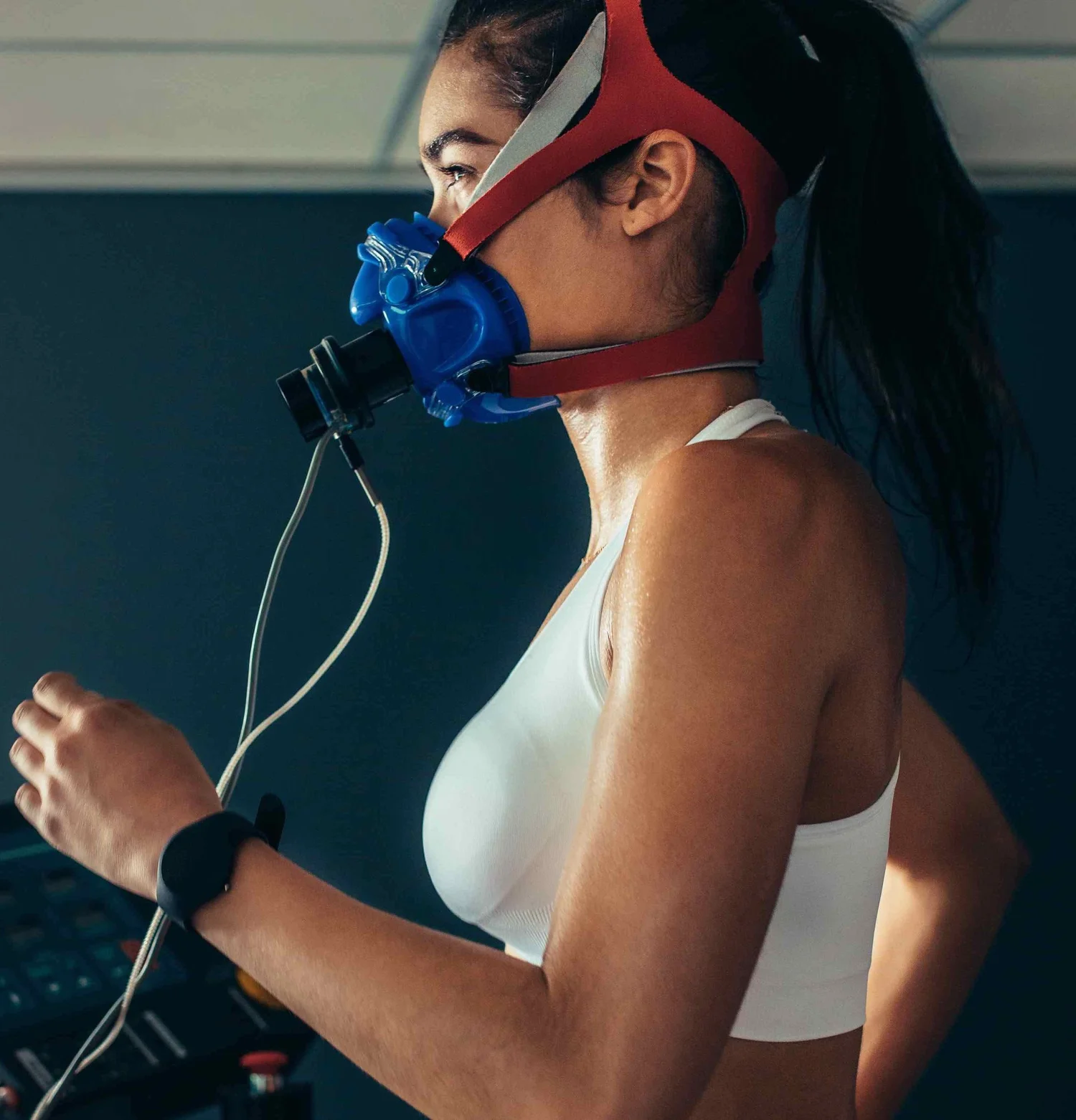
The maximum amount of oxygen your body can use under load — the single best-studied marker of cardiovascular fitness.

What your body burns at rest, measured rather than estimated from a calculator that has never met you.
One hour in the lab in Santa Monica, and you’ll know exactly how your body produces energy — and precisely how hard to go.