What lactate threshold testing is
A blood lactate test measures how your body produces and clears lactate as intensity rises, which gives you your aerobic and threshold training zones. It is the most precise picture of the intensity you can actually hold — and the test to book when the goal is to get faster and improve performance.
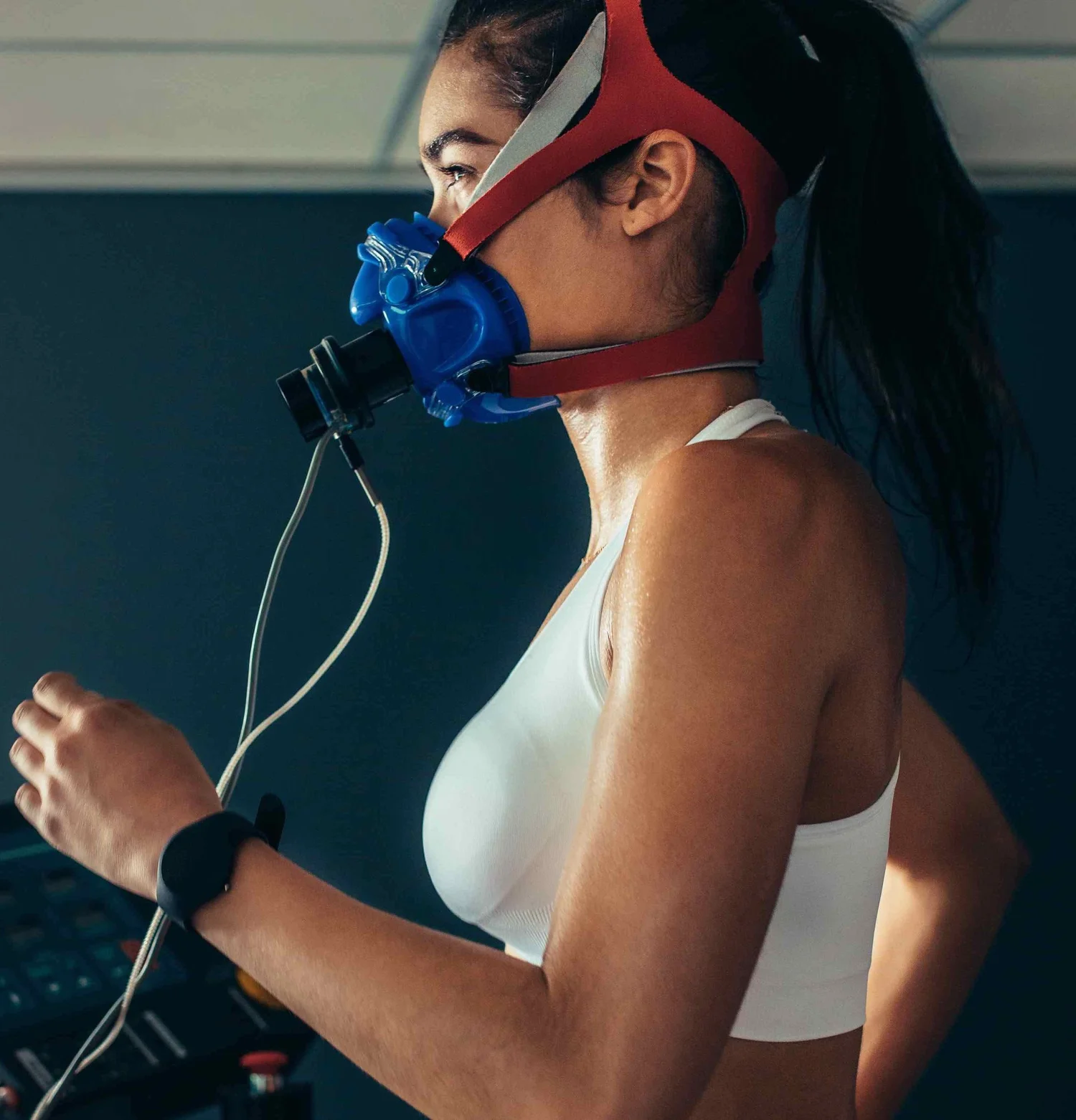
It is not a VO2 max test. VO2 max measures the maximum amount of oxygen your body can use during intense exercise, which gives you an aerobic ceiling and a Fat-Max fuelling intensity. Lactate testing maps the thresholds underneath that ceiling. Race performance lives in those thresholds.
The two marks the test is looking for
The aerobic threshold, written AeT / LT1, is the ceiling on genuinely easy work. Most athletes train above this without knowing it. The steady-state threshold, written SST / LT2, is the hardest intensity you can hold at a stable lactate. That is the number that sets realistic race pace.
On a typical lactate curve the first mark sits at the top of Zone 2, at 2 mmol. The second sits in a narrow Zone 4 band just below and just above 4 mmol. Those millimole figures are illustrative of a staged response. They are not your personal numbers. Your marks are the ones on your own curve, from your own samples.
Fat-Max — peak fat oxidation, the intensity at which you burn the most fat per minute — and VO2 peak sit on the same visit if you add a VO2 max test. The blood test on its own is the zones and the two thresholds.
What actually happens in the hour
A test session takes 30 to 40 minutes of actual testing, progressing through 4 to 8 stages. Allow around an hour in total for setup and the consultation. You do not need to know any physiology before you arrive. You do not need to be fit. The protocol is scaled to whatever you can currently do.
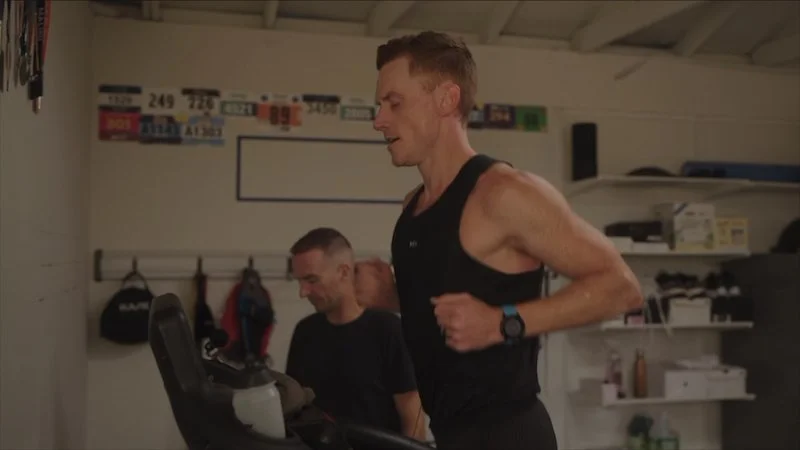
- Sport-specific setup. You test in your own discipline — treadmill for runners, ergometer for cyclists, pool for swimmers. The data is only useful if it comes from the movement you actually train.
- Staged, progressive load. The session steps up through 4–8 stages of increasing intensity. Each stage is held long enough for your body to settle at that effort before anything is recorded.
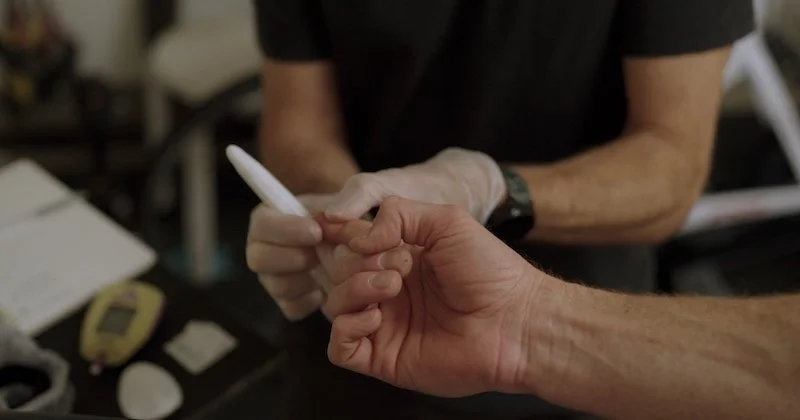
- A sample after every stage. A small blood sample is taken at the end of each stage with a fresh single-use needle. It takes seconds and you keep moving between stages.
- Gareth reads it with you. You do not get emailed a PDF and left to interpret it. Every test is read back in person, in plain language, with what to change on Monday morning.
Does the blood sampling hurt?
It is a small sample taken from a fingertip or earlobe with a fresh single-use needle after each stage, and it takes a few seconds. Most people describe it as a brief pinprick. You stay on the treadmill or bike throughout.
The needle is single-use and fresh at every stage. You are not taken off the machine to queue for a lab tech. Gareth takes the sample, the stage ends, the next one starts. That is the whole interruption.
The five training zones you leave with
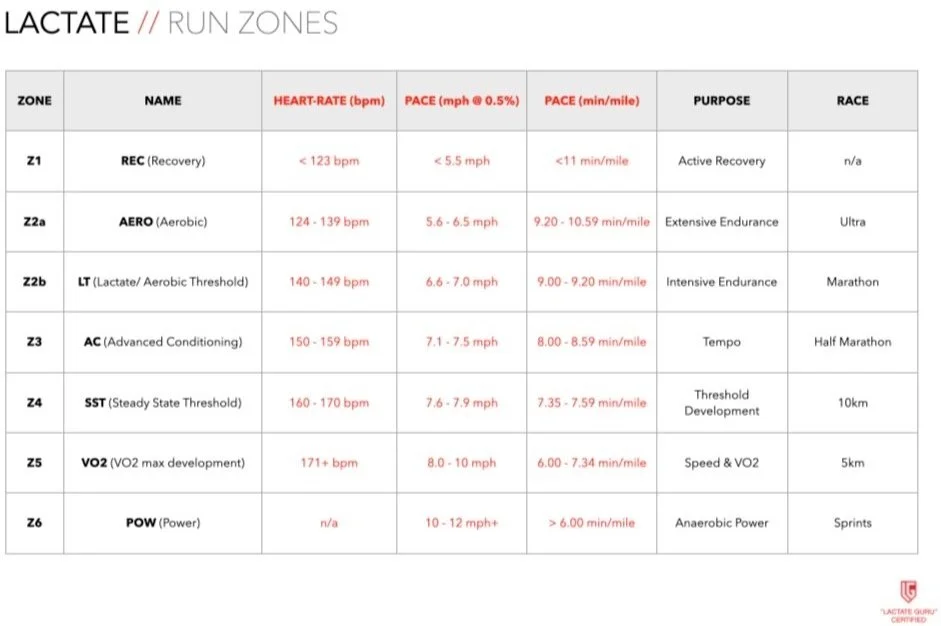
The zones are delivered as heart-rate and pace or power ranges you can load straight into a watch or head unit. They follow a five-zone model: a wide aerobic block, a narrow threshold band, and VO2 max work at the top.
- Z1 — Recovery
- Z2 — Aerobic (top of the zone is AeT / LT1)
- Z3 — Tempo
- Z4 — Threshold (the narrow band around SST / LT2)
- Z5 — VO2 max
What else is in the consult
You also leave with custom workouts built from your own numbers, and a fuelling and hydration plan. The consult is the point of the visit. The samples are how the numbers are made; the hour is how you find out what to do with them on Monday.
Every test at the lab is run by Gareth Thomas and explained by him. That is the difference. The equipment is not rare. A coach who will stand next to the curve and tell you the truth about your easy days is.
Who it is for, and what it costs
You do not need to be a serious athlete. Roughly half the people tested at the lab are not racing anything. The protocol scales. Driven people who want to reach their true potential — including people who hate racing and still want to train properly — are the usual appointment.
A blood lactate test is $350, and that is the Basic running and cycling package. Pro adds VO2 max at $575. Ultimate adds VO2 max and RMR at $675. For triathlon, Basic is lactate on bike and run at $575; Basic + is swim, bike and run at $775; Pro, Ultimate and Ultimate + add VO2 max and RMR from $950 to $1,250.
Every price includes the consultation and a full explanation of your results. Not sure which package? Call (858) 361-4733 and Gareth will tell you which one is worth your money.
How often to come back
Come back every 9 to 12 weeks. That is long enough for a training block to produce real physiological change and short enough that your zones do not drift out of date while you are still training to them.
The lab is ECLYPSE Fitness Lab at 1736 Ashland Avenue, Santa Monica, CA 90405, Tuesday to Friday 10–7, Saturday and Sunday 12–5, closed Monday. Read the lactate threshold testing page for the booking path, or call the number above.